
Class 7 Worksheet on Short and Long Sentences

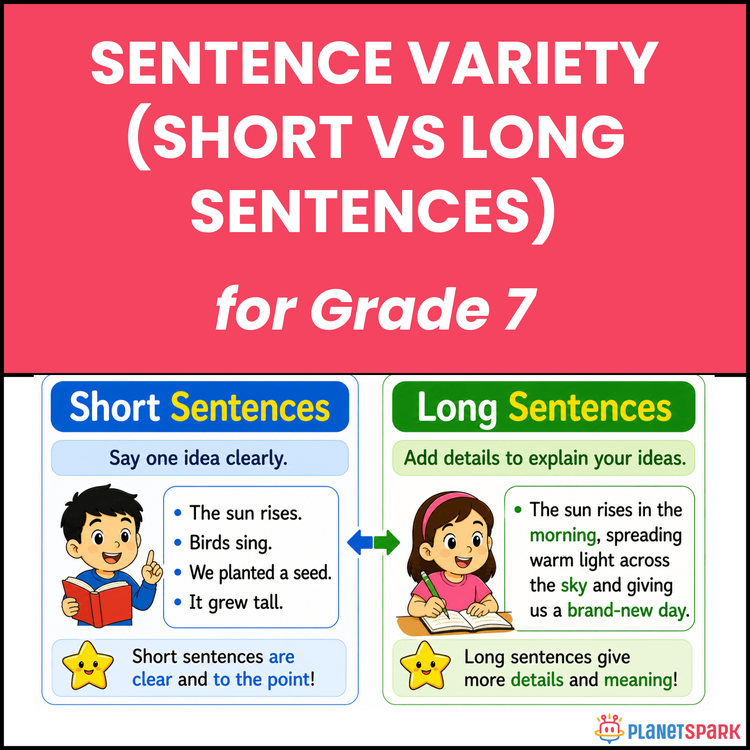
Class 7 Worksheet on Short and Long Sentences
Mix It Smart: Sentence Variety Mastery for Class 7
This Grade 7 worksheet on Sentence Variety (Short vs Long Sentences) helps students understand how to balance simple and expanded sentences to improve clarity, flow, and expression in writing. By practicing sentence expansion, combining ideas, and identifying structural differences, learners develop stronger control over how they communicate ideas effectively.
Why Sentence Variety Matters in Grammar?
Sentence variety plays a crucial role in making writing engaging and meaningful. For Grade 7 learners, this topic is important because:
1. It helps avoid repetitive and monotonous sentence patterns.
2. It improves clarity by combining ideas logically.
3. It enhances writing style through the use of phrases, clauses, and modifiers.
4. It builds strong communication skills for academic and creative writing.
What’s Inside This Worksheet?
Students move from identifying sentence types to actively constructing well-structured sentences through guided practice.
🧠 Exercise 1 – Identify Short and Long Sentences
Students underline long sentences and circle short ones, helping them visually distinguish between simple and expanded structures.
✏️ Exercise 2 – Multiple Choice Questions
Students choose sentences with embedded phrases, descriptive details, and proper sentence expansion. These questions test deeper understanding of sentence construction.
📋 Exercise 3 – Sentence Combining
Students combine short sentences using phrases, conjunctions, and modifiers. This builds the ability to expand ideas logically and fluently.
📝 Exercise 4 – Fill in the Blanks
Students complete a paragraph using appropriate grammar terms related to sentence structure, reinforcing conceptual understanding.
✍️ Exercise 5 – Paragraph Writing
Students write a paragraph on “A Busy School Morning” using at least two short sentences and two expanded sentences. They must include at least one clause and one descriptive phrase.
A strong response will include a mix of simple sentences (e.g., “I wake up early.”) and expanded sentences (e.g., “As I rush to catch the bus, I realize I forgot my notebook.”).
✅ Answer Key (For Parents & Educators)
Exercise 1 – Short vs Long Sentences
1. Short
2. Short
3. Long
4. Long
5. Long
6. Long
7. Long
8. Short
9. Short
10. Short
Exercise 2 – Multiple Choice Questions
1. b) Riya, preparing for finals, studies each evening.
2. c) Ravi plays cricket with focus after school.
3. a) Meera, listening closely, writes detailed notes.
4. a) Asha, seated near the window, reads quietly.
5. c) Raj, observed by the coach, runs with control.
6. c) The teacher explains while students listen attentively.
7. b) The boy, focused on revision, studies silently.
8. c) The bus arrives early.
9. c) The girl, managing distractions, completes homework.
10. a) The dog, attached to the boy, follows him daily.
Exercise 3 – Sentence Combining (Sample Answers)
1. Riya studies because she plans her time well.
2. Meera, listening carefully, writes notes.
3. Asha reads quietly as she prefers silence.
4. Ravi plays cricket even when he feels tired.
5. Raj runs fast while the coach observes him.
6. The teacher explains, and students stay attentive.
7. The bus arrives early today.
8. The girl completes her homework despite distractions.
9. The boy, focused on his work, studies regularly.
10. The dog, being loyal, follows him.
Exercise 4 – Fill in the Blanks
1. simple
2. descriptive
3. relative
4. clear
5. unnecessary
6. linking
7. sentence
8. logical
9. varied
10. overall
Exercise 5 – Paragraph Writing (Sample Answer)
A Busy School Morning
I wake up early. I pack my bag quickly. My mother, reminding me about my homework, checks my schedule before I leave. As I rush to catch the bus, I realize I forgot my notebook. The school gate is crowded, and students, talking excitedly, move toward their classrooms. I reach just in time. The bell rings loudly.
Help your child write more engaging and impactful sentences by mastering sentence variety with expert guidance and structured practice.
🔖Book a free trial!
Frequently Asked Questions
Using both short and long sentences helps students control pacing, improve clarity, and make writing more engaging for readers.
Because repeating the same sentence length makes writing dull, while variety improves readability and expression in CBSE English tasks.
They can combine short sentences into longer ones or break long sentences into smaller parts to understand structure.