
Class 7 Worksheet on Science Domain Vocabulary

Class 7 Worksheet on Science Domain Vocabulary
Explore Science Language: Domain Vocabulary for Class 7
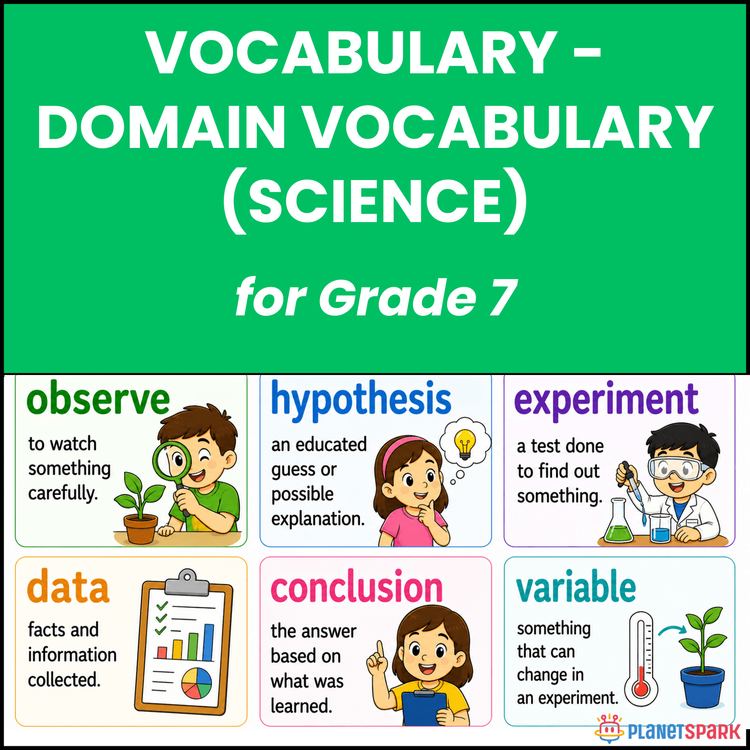
This Grade 7 worksheet focuses on essential science domain vocabulary, helping students understand key terms like experiment, observation, hypothesis, data, evidence, and conclusion. Through structured and engaging exercises, learners build a strong foundation in scientific language and thinking.
Why Science Vocabulary Matters in Learning?
Understanding domain-specific vocabulary is critical for success in science. For Grade 7 learners, this topic is important because:
1. It helps students understand scientific processes and concepts clearly.
2. It improves the ability to read and interpret science texts.
3. It strengthens logical thinking and reasoning skills.
4. It prepares students for experiments, reports, and exams.
What’s Inside This Worksheet?
This worksheet includes five structured exercises designed to build conceptual clarity:
🧠 Exercise 1 – True or False
Students evaluate statements about key science terms like experiment, observation, and hypothesis (page 3).
✏️ Exercise 2 – Sort the Words
Learners classify words into science process words and science result words (page 4).
📋 Exercise 3 – Fill in the Blanks
Students apply science vocabulary in context-based sentences (page 5).
📝 Exercise 4 – Multiple Choice Questions
MCQs test understanding of definitions and applications of science terms (pages 6–7).
🔁 Exercise 5 – Sentence Rewriting
Students correct incorrect meanings and reinforce accurate scientific concepts (page 8).
✅ Answer Key (For Parents & Educators)
Exercise 1 – True or False
1. True
2. True
3. True
4. False
5. False
6. False
7. False
8. True
9. False
10. False
Exercise 2 – Sort the Words
Science Process Words: experiment, observation, test, trial, record
Science Result Words: data, conclusion, result, finding, discovery, evidence, proof, report, inference, hypothesis
Exercise 3 – Fill in the Blanks
1. experiment
2. hypothesis
3. observation
4. data
5. conclusion
6. data
7. hypothesis
8. evidence
9. conclusion
10. observation
Exercise 4 – Multiple Choice Questions
1. b) a scientific test
2. b) an educated guess
3. c) noticing details
4. c) data
5. d) conclusion
6. c) data
7. d) evidence
8. c) hypothesis
9. d) conclusion
10. d) conclusion
Exercise 5 – Sentence Rewriting
1. Experiment means a scientific test.
2. Hypothesis means an educated guess.
3. Observation means noticing and recording details.
4. Data is used to study and analyze results.
5. Conclusion means the final result after testing.
6. Evidence is important in science to support answers.
7. Scientists use observations in labs.
8. Result means the outcome after an experiment.
9. Test and experiment are related scientific processes.
10. Observation means noticing details carefully.
Build your child’s confidence in science by mastering the vocabulary that powers experiments, reasoning, and discovery.
🔖Book a free trial!
Frequently Asked Questions
They help students understand subject-specific words, improving reading comprehension and confidence in both CBSE English and science learning.
It prepares children to understand textbook language faster and supports better comprehension of facts, processes, and scientific explanations.
They can read short science passages and note unfamiliar terms, then use those words in simple explanation sentences for better recall.