
Class 5 Worksheet on Using Dashes for Emphasis

Class 5 Worksheet on Using Dashes for Emphasis
Dash in Place of Commas for Strong Emphasis
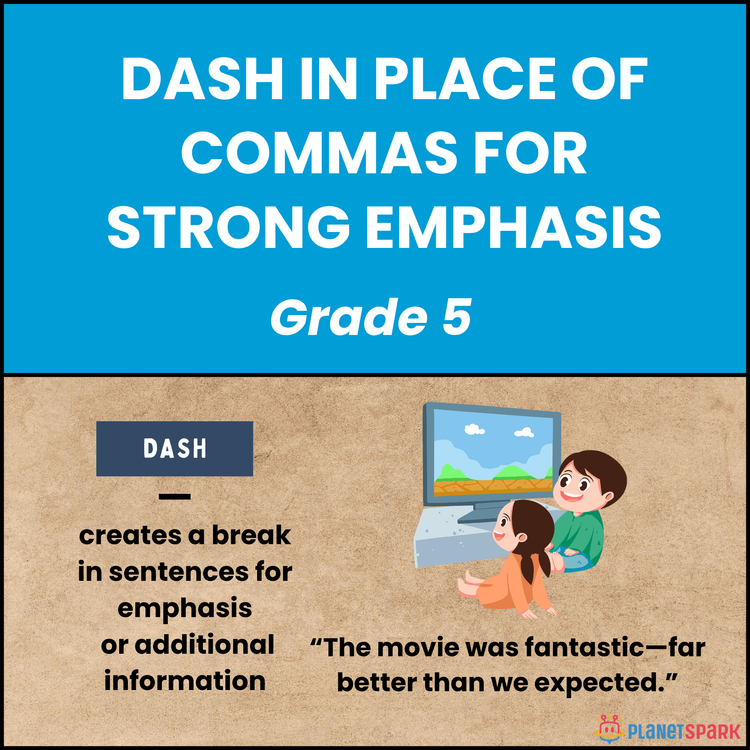
This Grade 5 worksheet is designed to help students understand the use of dashes in place of commas for strong emphasis. By using dashes, students can add emphasis or extra information within a sentence, which helps enhance the meaning and impact of their writing.
In this worksheet, learners will practice identifying and inserting dashes in sentences to convey meaning effectively. Activities include multiple choice questions, true/false statements, and rewriting sentences, all focusing on the usage of dashes for clarity and emphasis.
The exercises aim to help students differentiate between the use of dashes and commas, ensuring that they grasp when and how to use dashes in a variety of writing contexts.
Why Dashes Matter in Writing?
Dashes are important in grammar because they help to:
1. Add emphasis to certain parts of a sentence, making the meaning stronger.
2. Provide additional information without disrupting the flow of the sentence.
3. Show sudden thought breaks or interruptions in dialogue.
4. Make sentences more expressive, helping to convey a deeper meaning.
What’s Inside This Worksheet?
This worksheet includes engaging activities to practice the correct usage of dashes:
Exercise 1 – Choose the sentence with the correct dash usage:
Students must identify the correct use of dashes in a set of sentences. The activity helps students understand how to use dashes for emphasis and proper punctuation.
Exercise 2 – Tick True or False:
In this exercise, students determine if certain statements about dashes are true or false. It reinforces students’ understanding of dash rules and their application in writing.
Exercise 3 – Insert dashes in each sentence to show emphasis:
Students are given sentences and must insert dashes where emphasis is needed. This helps students practice using dashes in context and emphasizing important parts of a sentence.
Exercise 4 – Rewrite each sentence using a dash for emphasis:
Students will rewrite given sentences, adding dashes for emphasis. This exercise builds the ability to use dashes in place of commas for stronger meaning and clarity.
Exercise 5 – Read the paragraph and insert dashes wherever necessary:
Students read a paragraph and insert dashes to emphasize certain parts of the text. This activity helps students understand how to improve the flow and meaning of a passage using dashes.
By completing these activities, students will gain confidence in using dashes correctly and understand how they can make their writing more engaging and expressive.
Answer Key (For Parents and Educators)
Exercise 1 – Choose the sentence with the correct dash usage:
1. b) The train—delayed by rain—arrived late.
2. a) Ravi’s essay—well written and clear—was praised.
3. b) Asha—carrying books and bags—went to school.
4. c) Meera—always cheerful—helped her friends.
5. a) Riya—excited about cricket—ran fast.
6. b) Raj—who loves painting—created art.
7. c) The bus—packed with students—moved slowly.
8. c) The garden—bright with tulips—looked lovely.
9. a) The kite—high in the sky—flew beautifully.
10. b) The shop—near the station—sells snacks.
Exercise 2 – Tick True or False:
1. False
2. True
3. False
4. True
5. False
6. True
7. True
8. True
9. False
10. True
Exercise 3 – Insert dashes:
1. Rohit—who read books—learned quickly.
2. The garden—bloomed early—looked bright.
3. The student—studied hard—passed the test.
4. The cat—that ran fast—caught the mouse.
5. The bus—that was late—arrived finally.
6. Meenu—who loves painting—painted well.
7. Kabir—who plays football—scored a goal.
8. The kite—that flew high—reached the tree.
9. Tina—who practiced daily—improved fast.
10. Asha—who baked cookies—shared them.
Exercise 4 – Rewrite with a dash for emphasis:
1. The plan—simple yet effective—worked.
2. The cake—baked by Tara—was delicious.
3. The dog—running in the park—barked loudly.
4. The story—told by Pooja—was interesting.
5. Anaya—wearing a blue dress—danced gracefully.
6. Her boss—a demanding man—ordered a re-do.
7. Everything—even the kitchen sink—was gone.
8. The garden—full of roses—looked lovely.
9. Monika—reading quietly—solved the puzzle.
10. The winner—a young artist from Delhi—accepted the award.
Exercise 5 – Insert dashes in the paragraph:
The sun was high in the sky. All the children—even the shy ones—ran onto the grass. Maya brought her favourite toy—a red kite—to the park. The wind started to blow—soft at first—and then much faster. The kite—a bright splash of crimson against the blue—danced between the clouds. The kite soared over the trees. Everything seemed perfect until the string snapped. The kite drifted away in the wind. “Oh no!” Maya cried. Her friends—who tried to help her—ran across the field and found the kite. She tied a new knot—a double-loop special—to make it strong. The group sat down—tired but happy—under the big oak tree. They shared a snack—apples and juice—while they rested. The sky turned soft pink—the colour of a summer peach—as the day ended.
Help your child master dashes with a Free 1:1 Grammar Skills Trial Class at PlanetSpark.
Frequently Asked Questions
Dashes are used to add emphasis, provide additional information, or set off a part of a sentence, like "I can't believe it – she won the race!"
They might confuse dashes with commas or hyphens, making the sentence unclear or incorrectly punctuated.
Provide exercises where students can insert dashes for emphasis or additional explanation in sentences, such as "She was thrilled – no, overjoyed – with the news."